
As part of the mega plan, around 20 bridges, a number of tunnels, airbases and several key roads are being developed in strategically key areas in Arunachal Pradesh to bolster the overall military preparedness, officials said on Monday.

The Ministry of External Affairs said the two ministers discussed the outstanding issues related to disengagement from all friction points along the Line of Actual Control in eastern Ladakh.

Chinese Foreign Minister Wang Yi arrived in India Thursday evening in the highest-level visit between the two countries after the ties came under severe strain following the eastern Ladakh standoff nearly two years ago.
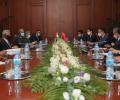
In a meeting on the sidelines of the summit of the Shanghai Cooperation Organisation (SCO) in Dushanbe on Thursday, the two foreign ministers exchanged views on the current situation in the region and agreed that military and diplomatic officials of both sides should meet again and discuss resolving the remaining issues at the earliest.

India on Thursday once again called for completion of the disengagement process at the remaining friction points in eastern Ladakh to pave the way for both the Indian and Chinese troops to consider de-escalation and ensure full restoration of peace and tranquillity in border areas.

The former Chief of Army Staff said India faces the most complex threats and challenges spanning a full spectrum of possible conflict -- from nuclear to sub-conventional -- but asserted that the armed forces are ready to deal with them.

Singh, in his address to the Indian-American community in San Francisco, also sent a subtle message to the United States that New Delhi does not believe in a diplomacy of 'zero-sum game' and its relationship with one country cannot be at the expense of the other.

China has been taking "incremental and tactical actions" to press its claims at the Line of Actual Control (LAC) with India and has unsuccessfully sought to prevent New Delhi from deepening its relationship with the US during and subsequent to the standoff, the Pentagon has said in a major report on China's military modernisation.
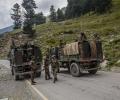
Top commanders of the Army on Thursday carried out a comprehensive review of India's overall security challenges including in eastern Ladakh as well as other sensitive areas along the Line of Actual Control with China on the first day of a two-day conference, people familiar with the development said.

'In Eastern Ladakh the Chinese attempted salami slicing.' 'Our response has been superb. Our military has responded magnificently.'

Tan said that China has always stressed that military cooperation of relevant countries, especially on exercises and training activities, should not be targeted at any third party, but rather serve to help maintain regional peace and stability.
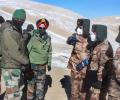
Foreign Secretary Harsh Vardhan Shringla terms India's relationship with China as "complex".
The country will not allow any "unilateral action" on its border and will pay any cost to thwart such attempts, he told the Bharatiya Janata Yuva Morcha's state conference.

His attack on the government came a day after Defence Minister Rajnath Singh assured Parliament that India has not conceded anything in the sustained talks with China and it will not allow even an inch of its territory to be taken away by anyone.
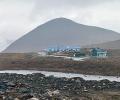
China's national legislature -- the National People's Congress (NPC) -- on October 23 adopted the new law on the protection and exploitation of the land border areas which drew sharp reaction from India as it was passed amid the protracted military standoff between the two sides in eastern Ladakh region.
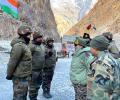
'We hope this round of meeting, on the basis of previous meetings, can move forward, further enlarge consensus, narrow differences and work for a solution that is acceptable to both parties,' the spokesperson said in updated comments posted on the ministry's website.
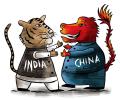
India and China achieved a major milestone this year when their bilateral trade crossed the landmark figure of $100 billion but it did not generate any fanfare in both capitals as the two Asian giants are going through a "particularly bad patch" in their relations due to a set of actions by Beijing in violation of agreements that led to the military standoff in eastern Ladakh. Starting with a modest $1.83 billion in 2001, the bilateral trade crossed $100 billion-mark in the first 11 months this year, a significant milestone for which the two countries carried out campaigns to boost trade and build it as a major stakeholder to improve the relations between two nations, whose ties otherwise remained frosty over the festering boundary dispute and strategic rivalry. According to last month's data from China's General Administration of Customs (GAC), the India-China bilateral trade totalled $114.263 billion, up 46.4 per cent year-on-year from January to November 2021.
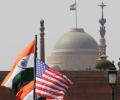
The official told the reporters during a conference call on Friday, ahead of the next week's 2+2 India-US Ministerial in New Delhi, that the Trump administration was providing support to India through defence sales, joint military exercises and information sharing.

External Affairs Minister S Jaishankar said on Friday that India and China are going through a 'particularly bad patch' in their ties because Beijing has taken a set of actions in violation of agreements for which it still doesn't have a 'credible explanation' and it is for the Chinese leadership to answer where they want to take the bilateral relationship.
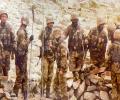
Jaishankar said China, in violation of the 1993 and 1996 agreements not to mass troops on the Line of Actual Control, chose to do so, and added that its attempt was obviously to unilaterally change the LAC.
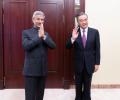
External affairs minister S Jaishankar has told his Chinese counterpart Wang Yi that the two sides should work for an early resolution of the remaining issues along the LAC in eastern Ladakh to restore peace and tranquility in the border areas as this has been an essential basis for progress in Sino-India ties.

Four Chinese soldiers were killed in the fierce clash with the Indian Army in the Galwan Valley in eastern Ladakh in June last year, the People's Liberation Army (PLA) acknowledged for the first time on Friday.
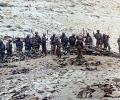
India on Thursday blamed China's actions of amassing a large number of troops close to the border and attempts to unilaterally alter the status quo along the Line of Actual Control (LAC) last year for the continuing military standoff in eastern Ladakh, and asserted that these acts were in violation of Sino-India bilateral agreements.
'The Galwan Valley clashes helped us prioritise our national security approach towards the northern border'

Making a statement in Lok Sabha, Singh also said the Indian Army has inflicted heavy costs including casualties on the Chinese side during the clash with the People's Liberation Army at the Galwan valley on June 15.
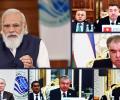
The Shanghai Cooperation Organisation (SCO) will hold its first in-person summit in Samarkand in Uzbekistan on Thursday after two years, shaking off Covid fears and providing a rare opportunity for all its eight heads of state to meet on the sidelines of the event to have face-to-face talks on pressing global and regional issues of common concern.
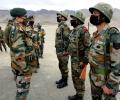
The seventh round of military talks between India and China held on Monday was "positive and constructive", and both sides agreed to earnestly implement the understanding reached by their leaders to not turn differences into disputes, a joint statement by the two armies said on Tuesday.

The talks took place in a beach resort in Benaulim on the sidelines of a meeting of the Council of Foreign Ministers of the Shanghai Cooperation Organisation.

He also said it was important that even during the difficult moments of this "crisis" India has been communicating and engaging with China.
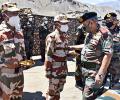
India and China should be able to achieve status quo in eastern Ladakh in a gradual manner as both sides understand that it is in the best interest of ensuring peace and tranquillity in the region, Chief of Defence Staff General Bipin Rawat said.
Lou also spoke about China's tensions with neighbouring countries without directly mentioning the eastern Ladakh border standoff with India since May 2020 which resulted in the Galwan Valley clash in June of that year.

'Wang Yi said the border issue is important and we should stay committed to peacefully addressing it through consultation and coordination.'

"I am very concerned about the recent situation of COVID-19 pandemic in India. On behalf of the Chinese Government and people, as well as in my own name, I would like to express sincere sympathies to the Indian Government and people," according to the message from President Xi to Prime Minister Modi.

Disengagement from the LAC will remain a chimera because China has given enough indications that the PLA will not move back any more. China has even deployed drones to monitor and deny any patrolling by Indian troops even in the buffer zones which are all in Indian Territory, explains Lieutenant General Prakash Katoch (retd).
Talking about dealing with the border issue faced by India, Jaishankar, without naming any country or going into details, said, "You know again we did what we had to do. There was a very active debate which still continues to this day. It is natural for people to offer advice, often on matters which they may not have particular knowledge of, that are a human trait. But again if there was what came through it was that we were resolute, we were strong about protecting our interests."
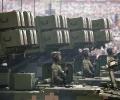
China hiked its annual defence budget by 7.1 per cent.
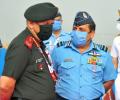
Gen Rawat's comments about the supporting role of the Air Force came at a conference when asked about the growing perception that the Indian Air Force was not keen on setting up the proposed theatre commands integrating the capabilities of the three forces.

On the first anniversary of the deadly clashes, the army said the supreme sacrifice of the soldiers while fighting the adversary in the "most difficult" high altitude terrain will be "eternally etched" in the memory of the nation.

In the midst of rising global concern over China's military expansionism, India and three other member nations of the Quad on Thursday vowed to uphold a rules-based international order underpinned by respect for territorial integrity and sovereignty, freedom of navigation and peaceful resolution of disputes.

Recalling the Galwan incident, he said the bravery, valour and restraint shown by the Indian Army are incomparable and unparalleled.
 © 2026 Rediff.com - Advertise with us - Disclaimer - Privacy Policy - Sitemap - Feedback - About us - Terms of use - Grievances